Google Is Quietly Building an AI for Everything (And No One Is Noticing)
Published: May 1, 2026
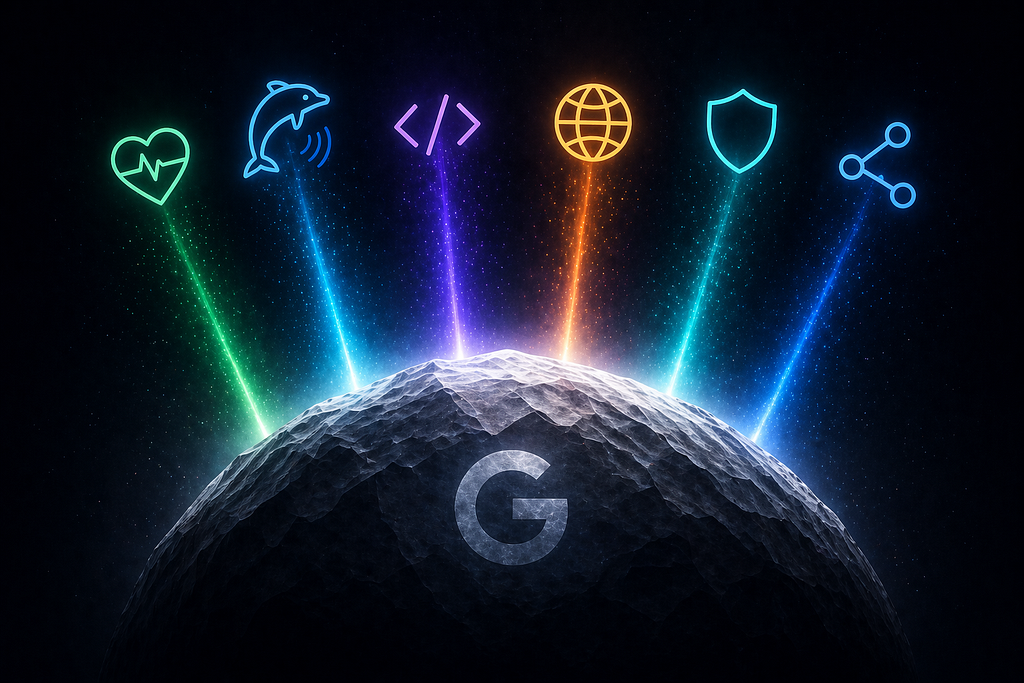
Beyond Gemini
An ecosystem of focused AI models is replacing the “one model does all” approach.
From cancer detection to dolphin communication, Google’s open-weight Gemma models are evolving into the most diverse specialized AI ecosystem developers can actually use.
Most people think Google’s AI strategy is Google Gemini.
The big model.
The flagship.
The one that tries to do everything.
But while everyone is watching Gemini…
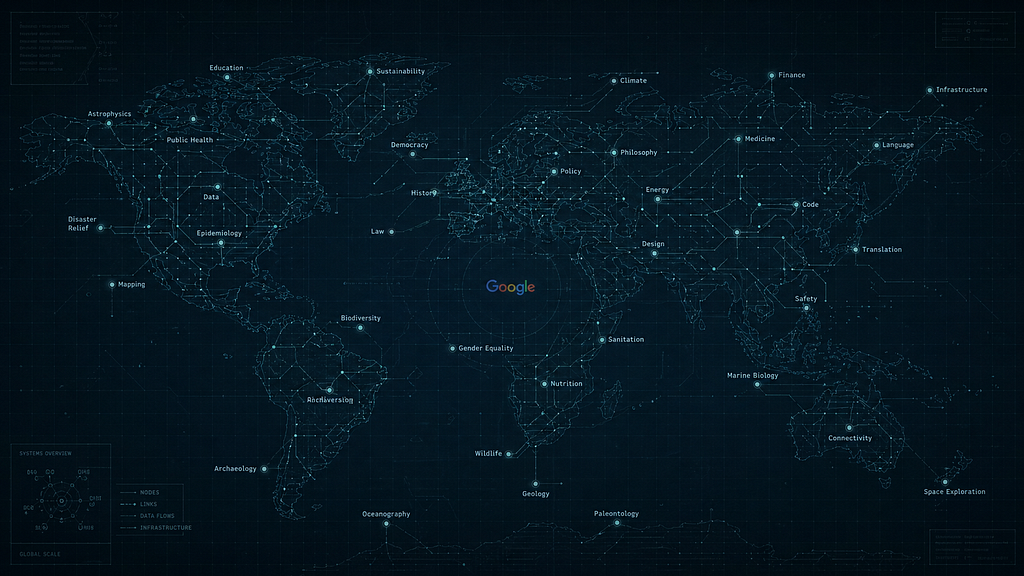
Google is quietly building something far more dangerous:
AI that doesn’t try to do everything — it tries to do one thing perfectly.
And almost nobody is talking about it.
We are witnessing the rise of Google Gemma specialized AI models. An ecosystem where developers can run models locally, fine-tune them, and avoid API lock-in entirely.
The Gemmaverse Is Bigger Than You Think
Google Gemma started in early 2024 as a lightweight alternative to Gemini.
A set of modest, open-weight AI models that developers could actually download and run locally. Two sizes. Modest ambitions.
Then something unexpected happened.
- 400M+ downloads
- 100K+ community variants (explore ecosystem: HuggingFace)
- Massive developer experimentation
And Google started listening very carefully to what people were doing with them.
And the signal was clear:
Developers didn’t want bigger models.
They wanted sharper ones.
So Google changed direction.
Not toward scale.
Toward specialization.
One Family. Dozens of Domains.
Here’s what most people don’t realize:
Gemma is no longer a model.
It’s becoming an operating system for domain-specific AI.
Instead of one general intelligence…
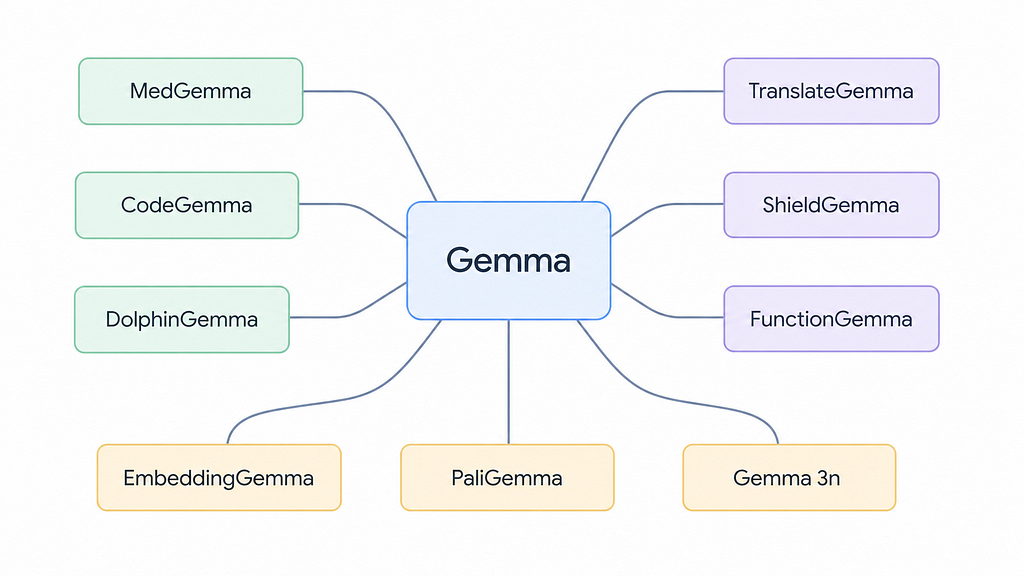
Google is building purpose-trained models, optimized for specific tasks:
- Medicine
- Code
- Translation
- Safety
- Search
- Edge computing
This is a shift from intelligence → infrastructure.
Let’s break down the most fascinating branches of this ecosystem.
MedGemma: AI That Understands Medicine
MedGemma is built on advanced Gemma 3 and fine-tuned specifically for medical data, text, imaging, and clinical reasoning.
This isn’t generic AI trying to “understand healthcare.” (see Google Health)
This is an AI trained to think in a medical context.
It’s designed for tasks like reading medical imaging, parsing clinical notes, and supporting diagnostic reasoning, the kind of work that typically requires either a trained clinician or an extremely expensive proprietary model.
Real-world example:
A team in Gurgaon used it to build a diabetes management tool running entirely on their own infrastructure.
- No API dependency.
- No data is leaving their system.
That’s a big deal.
Because in healthcare, privacy isn’t optional — it’s existential.
⚠️ Important: MedGemma is not clinical-grade yet.
It shouldn’t replace doctors.
But that’s not the point.
It replaces the busywork around doctors.
- Intake summaries
- Documentation
- Symptom structuring
That alone is massive.
DolphinGemma: The Model That Breaks Your Mental Model
DolphinGemma is where things get weird and important.
DolphinGemma is roughly ~400M parameter model built with Google DeepMind, Georgia Tech, and the Wild Dolphin Project.
Its purpose?
Understanding dolphin communication.
- Not text.
- Not images.
Dolphin vocalizations.
Let that sink in.
This isn’t an experiment.
This is proof that LLM architectures can escape human language entirely.
And it forces a question:
And it raises a profound question worth sitting with: if you can train a specialized language model to parse the high-frequency click-and-whistle sound patterns of dolphins, what can’t you build a domain-specific model for?
DolphinGemma serves as a proof of concept in the most literal sense. It is irrefutable proof that the Gemma architecture is flexible enough to work far beyond the standard text-and-image domains that people usually associate with LLMs.

CodeGemma — The End of Cloud Subscriptions?
CodeGemma comes in highly optimized 2B and 7B-parameter sizes, trained explicitly for code completion, debugging, and general software engineering tasks.
Not scraped knowledge.
Not AI that also codes.
It supports:
- Python
- JavaScript
- TypeScript
- C++
- Java
It integrates naturally into the broader open-source ecosystem (GitHub).
And here’s the real advantage:
- A smaller, specialized model fine-tuned on your codebase
- Can outperform a massive general model.
That flips the usual assumption:
Bigger ≠ better.
Closer to the problem = better.
The Others You Probably Haven’t Heard Of
The Gemmaverse doesn’t stop at the three above. It keeps going:
TranslateGemma
TranslateGemma is available in 4B, 12B, and 27B sizes and is built to help people communicate across 55 languages. Not a general translation dedicated translation architecture.
55-language communication layer
ShieldGemma 2
ShieldGemma 2 — A robust 4B image safety classifier. It outputs real-time safety labels across dangerous content, sexually explicit material, and violence categories. It acts as a ready-made content moderation layer that any backend developer can instantly drop into their ingestion pipeline.
Built-in safety classification
FunctionGemma
FunctionGemma — A staggeringly small 270M parameter model built specifically for robust function calling at the edge.
It is tiny.
It is fast.
It is designed precisely to work on constrained hardware where sending every structured JSON request to a cloud API isn’t practical, stable, or affordable.
Ultra-light edge function calling
EmbeddingGemma
EmbeddingGemma — Sitting at 308M parameters, this is purpose-built for generating embeddings — the core numeric representations that power semantic search, dense RAG (Retrieval-Augmented Generation) pipelines, and modern recommendation systems.
semantic search + RAG backbone
PaliGemma 2
PaliGemma 2 — A dynamic vision-language model available in 3B, 10B, and 28B sizes, designed for multi-modal tasks that require a deep understanding of both complex images and text simultaneously.
Vision + Language reasoning
Gemma 3n
The “n” stands for on-device.
Optimized specifically for mobile and edge hardware. E2B and E4B variants that run efficiently on Android devices and laptops.
Each of these is a focused tool — not a general-purpose assistant trying to do everything.
Optimized for on-device deployment
Each model is a tool, not a general assistant.
Here’s the Shift Most People Are Missing
Everyone is focused on:
- Benchmarks
- Arena rankings (see Chatbot Arena)
- “Which model is #1?”
They debate which model beats which at MMLU or HumanEval.
That’s the wrong game.
That’s not the game Google is playing with Gemma.
The future of AI isn’t one model dominating everything.
It’s many models dominating something.
This is the “surface area strategy.”

Gemma 4 just launched in April 2026 under an Apache 2.0 license — fully open for commercial use. That’s not a small detail. It means a startup can build a clinical documentation tool on MedGemma, a content moderation system on ShieldGemma, and a multilingual customer support tool on TranslateGemma, all without a usage agreement, a legal review, or a per-token bill.
Cover enough use cases…
And you don’t need to win the benchmark war.
You win the ecosystem.
What Google Gemma Specialized AI Models Mean for Developers Right Now
This isn’t just product design.
It’s positioning.
If you’re building any software in 2026 that touches a specialized domain, the first question worth asking yourself isn’t “which frontier API should I call?”
It is: Is there a Gemma variant for this?
Now a startup can build:
- Healthcare tools → MedGemma
- Dev tools → CodeGemma
- Moderation → ShieldGemma
- Search → EmbeddingGemma
Without asking permission.
That’s not a model advantage.
That’s an ecosystem advantage.
With Gemma 4 (Apache 2.0 licensed), Google removed:
- API lock-in
- Usage restrictions
- Cost barriers
The only thing left is to start.

Here are some Questions which might be bothering you, I’ll clarify right now:
What are all the Google Gemma model variants?
Here’s a quick breakdown of the most interesting ones:
Gemma 4: The core general-purpose foundation model (available in 4 sizes).
MedGemma: Optimized for medical text parsing and clinical imaging.
CodeGemma: Purpose-built for code completion and offline development.
TranslateGemma: Dedicated translation architecture spanning 55 languages.
ShieldGemma 2: Image safety and content moderation classification.
FunctionGemma: Edge-optimized, ultra-lightweight function calling.
EmbeddingGemma: Built specifically for semantic search and RAG embeddings.
PaliGemma 2: Multi-modal vision-language understanding.
Gemma 3n: Highly optimized for on-device and mobile hardware.
DolphinGemma: Experimental model for marine biology and cetacean acoustic analysis.
Is MedGemma safe to use in clinical settings?
Not yet for final, unassisted diagnosis — Google explicitly states MedGemma isn’t clinical grade. But it is a remarkably strong foundation for building healthcare-adjacent tools: documentation workflows, triage support, intake summarization, and medical imaging assistance, where a human clinician ultimately reviews the output. Developers should treat it as powerful infrastructure, not a replacement for human clinical judgment.
Can I use Gemma models commercially?
Yes. Gemma 4 is released under the Apache 2.0 license, making it fully usable in commercial applications.
What is the difference between Gemma and Gemini?
Gemini is closed and API-based.
Gemma is open-weight and locally deployable.
How does DolphinGemma work?
It applies transformer-based modeling to dolphin vocalizations, treating sound patterns similarly to language sequences.
Considering all of the facts
Google’s biggest AI bet isn’t building the smartest model.
It’s building the most useful collection of models.
And that’s a completely different game.
Everyone is watching the frontier race.
Bigger models.
Better benchmarks.
Flashier demos.
Meanwhile…
The landscape is shifting under our feet. Through Google Gemma specialized AI models, the future of development isn’t just getting smarter.
It’s getting hyper-specific, incredibly efficient, and radically open.
And developers are downloading it 400 million times.
A message from our Founder
Hey, Sunil here. I wanted to take a moment to thank you for reading until the end and for being a part of this community. Did you know that our team run these publications as a volunteer effort to over 3.5m monthly readers? We don’t receive any funding, we do this to support the community.
If you want to show some love, please take a moment to follow me on LinkedIn, TikTok, Instagram. You can also subscribe to our weekly newsletter. And before you go, don’t forget to clap and follow the writer️!
Google Is Quietly Building an AI for Everything (And No One Is Noticing) was originally published in Artificial Intelligence in Plain English on Medium, where people are continuing the conversation by highlighting and responding to this story.

