I Let Claude Code for Me for 30 Days. Here’s What Nobody’s Telling You.
Published: April 29, 2026

Beyond Productivity
It wasn’t the output. That part got better. It was something else, slower, quieter.

Around day 15, I noticed something.
I got stuck on something that shouldn’t have slowed me down.
I was debugging a Node.js issue, a fairly routine Redis connection timeout.
The kind of thing I’d fixed probably thirty times in the past two years, that it usually doesn’t take long to at least guess what’s wrong.
But this time?
But I just sat there…
Not stuck exactly. Just… waiting a bit. Like I’d forgotten the first move.
And then it clicked:
I wasn’t trying to figure it out. I was waiting for Claude to say something first.
That part bothered me more than the bug.
That was the moment I realised something had shifted.
Not in Claude. In me.
This isn’t really about “AI makes you worse”
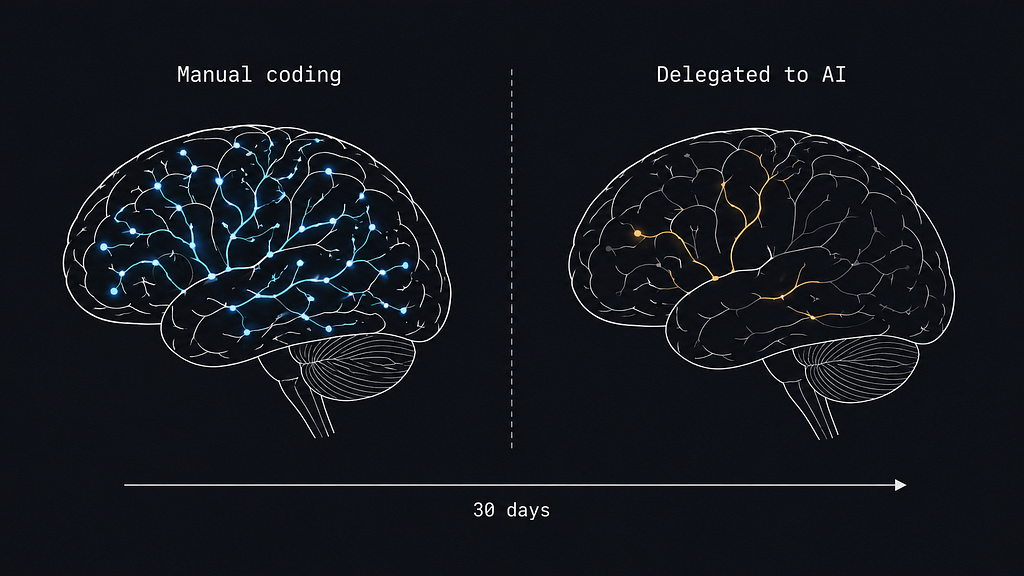
Agentic coding skills don’t disappear overnight. They drift.
You delegate a task. Claude handles it well. You delegate another.
Over 30 days of using Claude Code heavily, tool calls, multi-step tasks, full feature builds, I started noticing specific things getting slower.
Not my output. My instincts.
There’s a loud debate happening right now:
- This makes you 10x faster
- Or this will replace developers
The honest answer to “Does letting AI code for you makes you worse?”
You don’t get worse at shipping.
You get weaker at the things you’d need if the AI disappeared tomorrow.
That distinction matters more than most people are willing to say out loud.
What I Actually Tracked
I want to be clear about what I mean when I say I “tracked” this, because I’m not reporting a controlled experiment.
I kept notes.
I paid attention to how long certain tasks took me when I did them manually, and compared that to how they felt a month earlier.
A few patterns kept repeating:
1️⃣ Debugging instinct slowed down.
Earlier, if something broke, I’d start forming a guess almost immediately.
Now, because my first instinct was now “let me ask Claude” rather than “let me think”.
“Let me just paste this and see what Claude says”
If you’ve ever pasted an error into AI before thinking, you’ve probably felt this.
It sounds harmless.
And sometimes it is.
But something subtle changes:
You stop initiating the diagnosis.
2️⃣ I was “reading” code without really reading it.
When Claude generates code, you review it.
But you don’t read it the way you’d read code you wrote yourself.
I caught myself approving chunks that I understood at a high level but couldn’t fully explain if you stopped me mid-way.
That’s new. I didn’t love that.
And honestly, a bit uncomfortable.
3️⃣ My mental model had gaps
This one’s the hardest to explain.
When you write code yourself, even messy code, you kind of own the structure.
When AI writes it:
You inherit the result, not the reasoning.
I started noticing moments where I knew what the system did… but couldn’t easily explain why it was shaped that way.
Not a great feeling during debugging.
I don’t think this is a “problem” with Claude
This is a problem with how humans learn.
It feels more like a side effect of how brains work.
There’s research from cognitive science on how skill retention works under assisted performance.
The core finding: when a tool reliably handles a task, the brain stops treating it as something worth retaining.
There’s a concept in cognitive science called cognitive offloading.
Same mechanism behind why GPS navigation genuinely degrades spatial memory with extended use. Same reason surgeons who rely heavily on robotic tools maintain strong outcomes but slower manual fallback times.
Same reason muscle memory fades if you stop using it.
Nothing new. Just happening faster because the handoff is frictionless.
You don’t decide to delegate. You just… do.
This is actually the same pattern I wrote about in the context drift problem — models losing track of instructions mid-conversation, developers losing track of their own reasoning mid-workflow.
Both are attention management problems.
One happens in the model. One happens in you.
If you would like to understand why your AI Agent forgets instruction and context mid conversation, check out my article on context drift here:
Your AI Agent Isn’t Dumb. It Has ADHD
What I changed (and yeah, none of this is dramatic)
I didn’t stop using AI.
I’m not going to tell you to stop using Claude Code. That’s not the lesson and it’s not what I did.

Here’s what actually changed how I work:
1️⃣ I force myself to have an opinion first
Before I hand a problem to Claude, I spend ~5 minutes on it myself.
Not solving it.
Just:
“I think this smells like a race condition in Redis”
Half the time I’m wrong.
Still useful.
Still valuable.
Because:
Forming a hypothesis keeps your diagnostic instinct alive.
AI can still do the heavy lifting.
But you stay involved in the part that actually builds skill.
2️⃣ If I can’t explain it, I don’t ship it
Clean code is dangerous.
Especially when you didn’t write it.
If I can’t explain a block of generated code in plain terms:
I don’t commit it yet.
Yes, it slows things down slightly. Some sessions added ten minutes.
Some sessions it exposed things I genuinely didn’t understand and would have shipped without noticing. I think the second case happened more than I’d like to admit.
3️⃣ I do one manual session per day, no AI
No philosophy here.
Just… Something done completely manually.
Bug fix, small function, whatever.
Just enough to keep the baseline from drifting.
I still find this slightly annoying, which is probably the point.
I still catch myself wanting to open Claude out of habit. Which probably says enough.
The Part I’m Still Working Out
I don’t know if what I noticed is actual skill decay or just adaptation.
After a few weeks of these habits, things feel sharper again.
I’ve been running these three habits for about three weeks and things feel sharper, but I genuinely can’t tell if that’s real recovery or just familiarity with a new workflow.
Also not sure how much any of this matters long term.
This still confuses me a little, honestly.
Also not sure how much this matters long-term.
If tools keep improving, maybe the baseline just shifts and this whole concern becomes irrelevant. Or maybe debugging becomes the one skill that really matters, and this gets more important.
Honestly, I’m guessing a bit here. I don’t have a clean take on that yet.
If there’s one thing I’d keep in mind
It’s not:
“Use AI less”
That framing feels wrong.
It’s more like:
Stay involved in the part where you’re forming explanations, not just accepting them.
Because the risk isn’t that AI writes bad code.
It’s that it writes good code that you only half-understand.
Because the weird moment for me wasn’t bad output.
It was sitting in front of a problem I understood… and hesitating.
Waiting for something external to kick things off.
And yeah, that moment stuck with me, Back to that Redis bug
I eventually fixed it.
It wasn’t even complicated.
Instead, I paused.
Looked at the screen.
And waited for Claude to say something.
That’s the part I’m paying attention to now.
Not the speed gains. Not the productivity graphs.

Just that small hesitation.
That was the tell.
The tools aren’t going anywhere. Make sure you aren’t either.
A message from our Founder
Hey, Sunil here. I wanted to take a moment to thank you for reading until the end and for being a part of this community. Did you know that our team run these publications as a volunteer effort to over 3.5m monthly readers? We don’t receive any funding, we do this to support the community.
If you want to show some love, please take a moment to follow me on LinkedIn, TikTok, Instagram. You can also subscribe to our weekly newsletter. And before you go, don’t forget to clap and follow the writer️!
I Let Claude Code for Me for 30 Days. Here’s What Nobody’s Telling You. was originally published in Artificial Intelligence in Plain English on Medium, where people are continuing the conversation by highlighting and responding to this story.

