The Jetson Paradox: AI Made Us More Productive, So Why Are We Still Falling Behind?
Published: January 23, 2026
I remember the first time I wrote a script that successfully automated a human out of a job.

It wasn’t malicious.
It was a ticket in the backlog:
Optimize data entry workflow
I spent three days writing Python. I tested edge cases. I shipped it to production.
The client was thrilled.
Error rates dropped to zero.
Efficiency gains were massive.
Two weeks later, I found out the three people who managed that workflow were let go.

In the tech industry, we call this shipping.
We high-five over improved metrics and reduced latency.
But for the last two decades, I’ve watched a disturbing pattern emerge from the systems we build.
We promised that technology would be the rising tide that lifts all boats.
We promised The Jetsons, a world where machines do the drudgery so humans can enjoy the leisure.
Instead, we built a paradox.
We have AI that can pass the Bar Exam and rockets that land themselves, yet the average person feels like they’re running on a treadmill that’s slowly speeding up.
The future arrived.
The prosperity stayed in the server room.
The Great Decoupling
Here’s the data point that keeps me up at night.
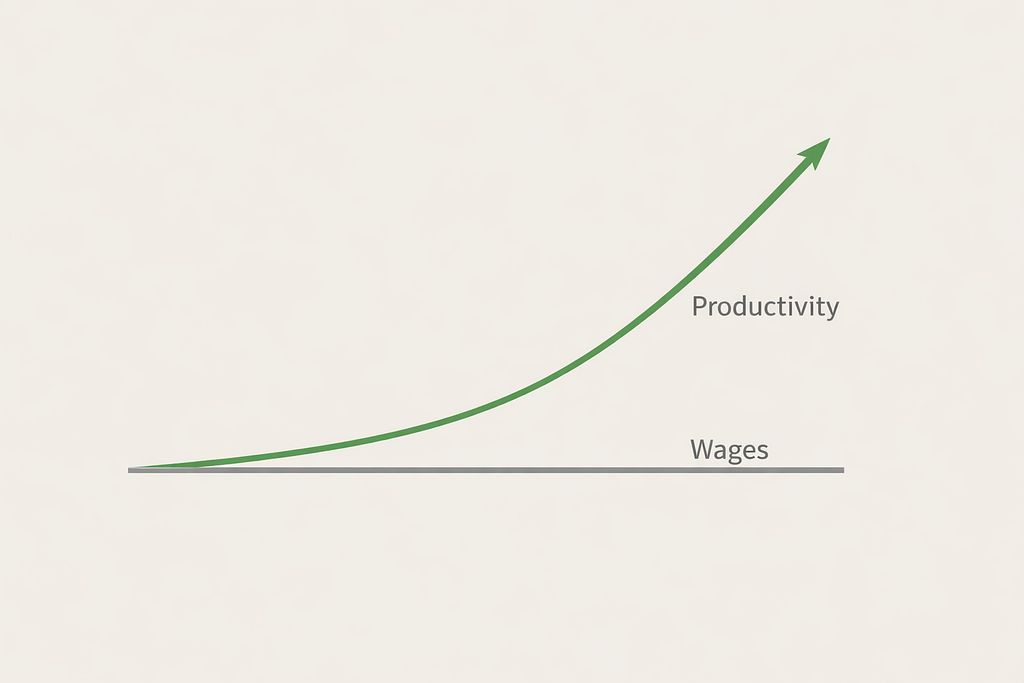
For most of the 20th century, productivity and wages were married.
If a factory figured out how to make 10% more widgets, workers took home roughly 10% more pay. It wasn’t written anywhere, it was an implicit social contract.
Around 1973, that contract was breached.
Productivity kept climbing — skyrocketing, actually — thanks to computers, the internet, mobile, and now AI.
Wages for the average worker? Flatlined.
That value didn’t disappear.
In my experience building enterprise systems, I know exactly where it went:
- Capital
- Shareholders
- And, honestly, people like me — the engineers designing the “magic”
We created a massive disconnect between Efficiency (how much wealth the system generates) and Equity (who actually gets the debit card).
Today, it’s possible to generate billions of dollars in value with a team of twelve people — while everyone else fights over scraps in the service economy.
Smashing Looms and the “End of Work”
It’s lazy to dismiss today’s fears as anti-progress.
Whenever I hear a venture capitalist mock people worried about AI, I think about the Luddites.
History class tells you they were anti-technology idiots who hated progress.
That’s propaganda.
The Luddites were skilled weavers.
They didn’t smash looms because they hated gears.
They smashed them because factory owners used machines to bypass labor standards and flood the market with cheap, low-quality cloth, starving skilled workers.
They weren’t fighting technology.
They were fighting poverty.
In 1930, John Maynard Keynes predicted “technological unemployment.” He believed we’d get so efficient we wouldn’t know what to do with ourselves. He imagined a 15-hour workweek for my generation.
He was right about efficiency.
He was wrong about human institutions.
We didn’t take productivity gains as time off.
We took them as higher output targets.
The difference today is speed.
- Farms → factories took generations
- Factories → cubicles took decades
- Cubicles → obsolescence is happening in fiscal quarters
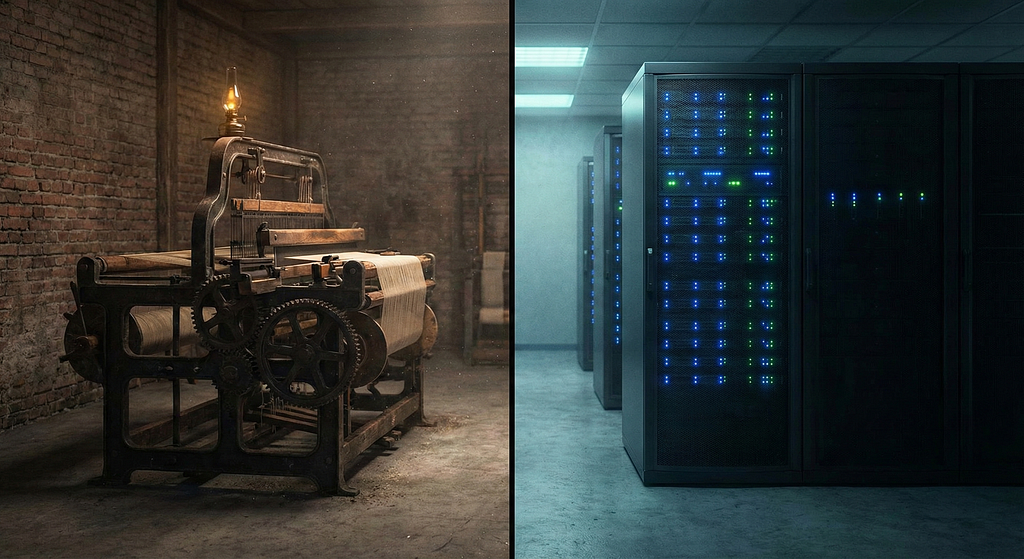
Human systems can’t patch themselves that fast.
The “Magic” Filter: Why Tech Wealth Doesn’t Trickle Down
Economists call it Skill-Biased Technological Change.
That’s a polite way of saying:
Technology loves educated people and quietly replaces everyone else.
If you’re a software engineer, AI is a lever — you get stronger.
If you’re a paralegal, copywriter, or support agent, AI isn’t a lever.
It’s a replacement.
We’re drifting toward an economy dominated by a handful of mega-companies — efficiency monsters that don’t need armies of workers. They need:
- A few thousand elite specialists
- Vast GPU farms
- Ruthless optimization
The real problem isn’t just that wealth is pooling at the top.
It’s that the ladder is being pulled up.
Entry-level jobs used to be paid learning.
You did the grunt work to earn experience.
Now we’re automating the grunt work.
I talk to junior developers and analysts who can’t get hired because AI already does the “junior” tasks faster and cheaper.
If you remove the bottom rungs, how does anyone ever climb?
The High Cost of Silicon Success
There’s another consequence — one you feel every time you pay rent.
Tech hubs like San Francisco, Austin, and Seattle operate on brutal math.
Drop 50,000 highly paid engineers into a city, and prices adjust to their spending power.
Housing.
Food.
Services.
Everyone else pays the success tax.

Teachers and firefighters don’t get equity grants, but they still pay tech-inflated rent.
I’ve hired six-figure engineers who still feel house-poor.
If the people building the future can barely afford to live in it, what chance does the barista serving them coffee have?
And the divide is no longer just about devices.
It’s about:
- High-speed connectivity
- Specialized knowledge
- Knowing how to talk to machines effectively
We’re building a caste system based on digital literacy.
The Optimist vs. The Realist
At conferences, I always hear the same argument.
The Optimist:
“The car killed the stable boy, but created mechanics and road builders. AI will create jobs we can’t imagine.”
I want to believe that.
The Realist:
Timeline matters.
The horse-to-car transition took forty years.
If AI displaces millions in five, “eventual” doesn’t pay rent next month.
There’s also a difference we avoid naming:
- Augmentation is a telescope, it helps you see further
- Replacement is an autonomous rover, it goes where you used to go
For decades, tech built telescopes.
Now we’re mass-producing rovers.
I’ve sat in meetings where the goal wasn’t empowerment, it was headcount reduction. Not culture. Not growth. OPEX.
We need to stop pretending the invisible hand automatically high-fives everyone.
Debugging the System
We can’t put the genie back in the server rack.
Nor should we.
The technology itself is miraculous. I want AI that cures cancer and solves fusion.
But the economic operating system is buggy.
1. Acknowledge the glitch
We need to stop lying that “AI won’t take jobs.”
It will. It’s designed to.
2. Patch the policy layer
UBI. Robot taxes. Aggressive reskilling.
If an algorithm replaces 100 workers, the output should support the society that made it possible.
3. Design for humans
As builders, we choose:
- Human-in-the-loop systems that elevate judgment
- Or black boxes that erase people
Augmentation is a telescope.
Replacement is a rover.
It’s a design choice.
We’ve built the most powerful wealth engine in history.

The question isn’t “Can we build it?”
We already did.
The real question is:
Who is it for?
Because if the answer is “shareholders only”
We didn’t build the future.
We built a highly efficient feudalism with better graphics.
The Jetson Paradox: AI Made Us More Productive, So Why Are We Still Falling Behind? was originally published in Write A Catalyst on Medium, where people are continuing the conversation by highlighting and responding to this story.

